Paper 1
Computer Systems
Data representation, data transmission, hardware, software, the internet and its uses, automated and emerging technologies.
1 hr 45 min · 75 marks · 50%
Class 9 – 10 · Cambridge 0478 / 2210
A two-year course for Cambridge IGCSE (0478) and O Level (2210) Computer Science, held in person at Mirpur and Uttara in Dhaka. Every topic is explained visually, practised with real exam questions and tested under exam conditions.
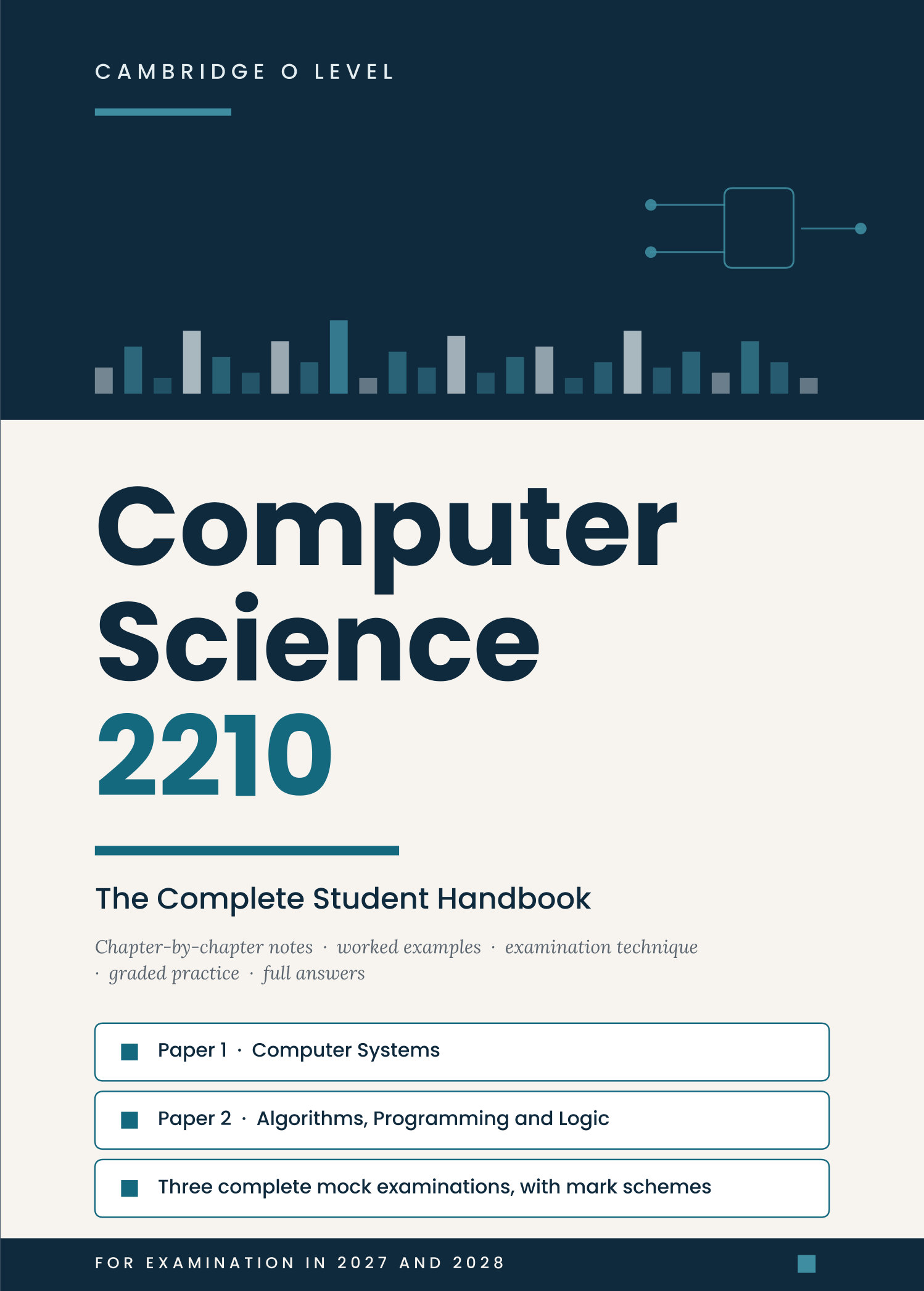
Cambridge IGCSE 0478 and O Level 2210 share one syllabus: how computers represent and move data, the hardware and software inside them, the internet and cyber security, emerging technologies such as robotics and AI — and, in Paper 2, algorithms, pseudocode, programming, databases and Boolean logic.
Classes run through Class 9 and Class 10. Each topic is first drawn and explained in plain words, then turned into pseudocode and Python, then practised with topical past-paper questions until the mark scheme makes sense. Timed mock exams in Class 10 build the speed and calm needed on exam day.
Students follow their progress on the student dashboard — homework, test marks against the class average, attendance and a syllabus checklist — and parents receive a monthly report.
The exam
Paper 1
Data representation, data transmission, hardware, software, the internet and its uses, automated and emerging technologies.
1 hr 45 min · 75 marks · 50%
Paper 2
Algorithm design and problem-solving, pseudocode and flowcharts, trace tables, programming, databases and SQL, Boolean logic.
1 hr 45 min · 75 marks · 50%
Syllabus 0478 / 2210
The whole syllabus is taught in class — nothing is left for students to work out alone.
Paper 1
Paper 1
Paper 1
Paper 1
Paper 1
Paper 1
Paper 2
Paper 2
Paper 2
Paper 2
Batches & centres
In-person classes at Mirpur Academia (Mirpur, Dhaka) and Uttara QED (Uttara, Dhaka).
Mirpur, Dhaka
Uttara, Dhaka
Class 9 · O Level / IGCSE
Class 9
Monday - Discussion & Demonstration, Saturday - Practice, Extra class Wednesday
Class 9
Wednesday - Practice, Monday - Discussion & Demonstration, Saturday - Makeup/Extra Class
Books for this course
Questions
Yes. Both follow the same Cambridge syllabus and sit the same two papers — 0478 is the IGCSE code and 2210 the O Level code. One class prepares you for either.
Two written papers of 1 hour 45 minutes and 75 marks each: Paper 1 Computer Systems and Paper 2 Algorithms, Programming and Logic. Each is worth 50% of the grade and there is no coursework.
The exam is written in Cambridge pseudocode, so every algorithm is practised in pseudocode first. Programs are then written and run in Python so students see their ideas work.
Ideally at the start of Class 9. The syllabus is covered over Class 9 and Class 10, with revision, topical past papers and mock exams before the May/June or October/November exam.
Yes. Pearson Edexcel International GCSE Computer Science (4CP0) covers much of the same content, and Edexcel students are welcome in the same batches.
No. The course starts from the very beginning — binary numbers, simple algorithms and first programs — and builds up step by step.
Register online, pick your centre and batch, and your seat is confirmed by the teacher.